

fbpx
Live your imaginable.

Tag: Jackie

How learning about my brain helped me cope with the Covid pandemic

Years from now, when we look back at our Covid experience and tell the stories to our grandkids, mine will definitely include this one. My journey through the pandemic ran in parallel to my learning journey of Neuro-Transformational Coaching, and I’m certain that this course saved me in many ways.

I had already registered to attend the face-to-face course in Singapore scheduled in March 2020, which is exactly when the world got locked down. The program leaders were quick to pivot and offered the online option soon after. I hesitated at first because I thought it would be better for me to wait for the next face to face offering instead. I knew my learning style would be better off with a live class than online. But after careful thought and still with a lot of apprehension, I decided to take the leap and joined the Azalea pod. In hindsight, this was probably the best gift I could give myself at a time when there were so many reasons to feel hopeless and helpless.

Not only did I learn how to support my coaching clients by understanding the brain-science behind the work I do, I also learned about how my own brain was operating and why I was experiencing this pandemic in the way I was. I felt supported by a wonderful group of women who were learning with me and experiencing this global crisis in their own ways, and holding such a compassionate space for each other as we were telling our stories. I learned from each of them by watching them coach, hearing their thoughts, and being inspired by their generosity.
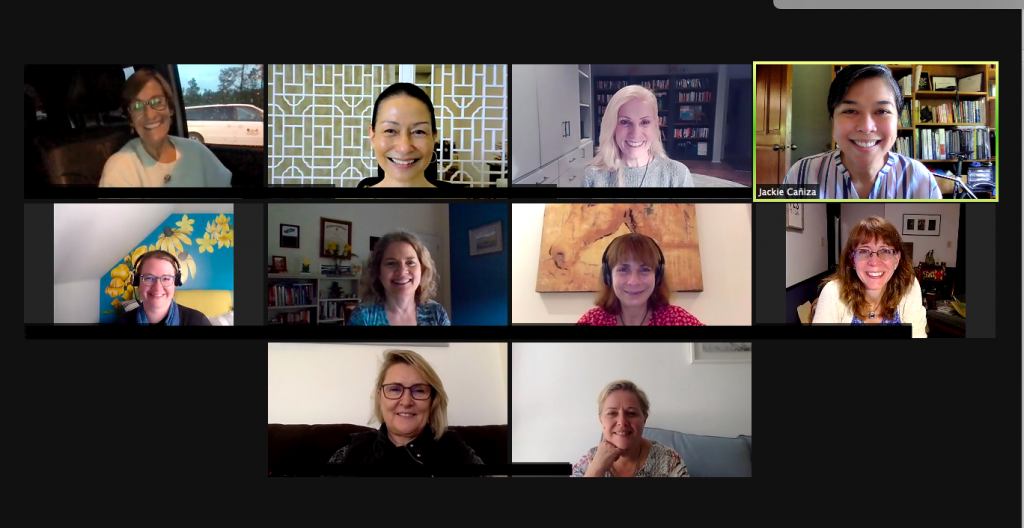
Today I received my certification telling me that I’m an official Neuro-Transformational Coach, which also means for me that I am a pandemic thriver!

Thank you, Ann, Ursula and the beautiful Azalea souls for walking with me in the past year. You earned a very special place in my heart!

On Starting a New Business

Someone asked me today, “What motivated you to start your own business?” Here is my response:

I’ve always had it as a dream at the back of my mind, like many people. What held me back was the fear of failure and absence of security, especially having young kids. But even while being employed I always strived to learn new things that I knew would come in handy when the right time came.. In the last year of my employment, I took the courage to ask for a new assignment that took me far away from my comfort zone and in a new realm of starting a new business model and channel for our company. It was in that assignment where I realized that I had already known enough to start something on my own. I thought,

“If I could successfully run a startup for this company, why couldn’t I do it for myself? If I spent the same amount of time, effort and energy on something that was mine, why wouldn’t it work? If I started a business that focused on the things I felt passionate about, I would never have to worry about how it pleased my boss or whether it would get the right support from the right people.”

It all worked out timing-wise too. Everything fell into place as far as my own resolve, the state of my employer and in my family. I really believe that once I felt absolutely certain about what I wanted, the universe just helped make it happen.

I haven’t looked back since. I get asked often if I miss being employed and if I would ever go back and I always answer vey quickly, “No.” Not that I didn’t love my job or my work environment because I did. I just can’t imagine not doing what I’m doing now. I still spend long hours working and I don’t have the same support system that I did as a senior executive, but I wouldn’t trade my job now for anything.

Plus it helps when you can give yourself any pretty title you want to

The Best Team – Why and How?

They say that if you find a job you love, you won’t have to work a day in your life. I would add that if you find a team you love, they will change your life for the better.

I’ve had the privilege of working with some amazing teams. Here’s what makes me believe I have the best team in the world today.

  • I’m not afraid to be who I am around them. I can be vulnerable, bare my soul and not have to worry about being judged or misunderstood.
  • We value our differences to the extent of learning from each other, and even relying on those differences to show us different lenses to view the world.
  • We make each other better. We set high goals for work AND for other areas of our life, and we hold each other accountable. We’re not afraid to call each other out. We’re honest and sometimes brutal, but we’re not mean. 
  • We take our work seriously, yet we can laugh at ourselves, our mistakes and our missteps. 
  • Everyone is growing and developing as a result of being part of the team.
  • Results are delivered, even beyond expectations. We have a lot of fun AND we get the job done pretty darn well.

How did we get to become this team? It didn’t happen overnight. We experimented and tried different things, and even failed a few times. Here are some of the things that I believe helped us get better:

  • We established routines that integrated catching up on each other’s lives, as well as the rigorous review of our work. For example, we check in on each other at the beginning of every face to face meeting, and we take time to listen to our personal stories.
  • We invested in tools and assessments that helped us gain a better understanding of each other’s personalities and strengths, and also to create room for developing ourselves in areas we’re most uncomfortable. We “pressure” one another to be and do better.
  • Everyone leads and everyone follows. In our team, there is no single leader. Each of us has a key role to play, and we lead in those roles. They change almost seamlessly when shifts need to occur. 
  • Each of us is constantly learning and trying new things that will benefit the team, so each of our roles are continuously growing. 

There are probably many other ways for a team to grow and develop, and we have yet to discover them. Meanwhile, we’re enjoying our time working, learning and growing together.

As a purposeful coaching company, we live what we believe. When we work with our clients to develop their teams, we don’t just use theories but our own experience in bringing them to life. Of course, each team is unique and that is why we also love learning from the teams we support so we can co-create their version of the best team ever. 

Just Trust in What You Know

I had always wondered if I could start a business of my own and never really felt quite ready to do it. My career was mainly in the field of HR and I knew that running a business was much, much more than that. The only way I could find out if I was ready was to just jump and try it.

I mustered up all the courage I could find in my gut and had a serious talk with my boss and asked for an assignment to lead a project that would implement a new channel for our business. I had no experience but I knew I felt passionate about the project and had good management skills and that’s what I told him. “I had nothing to lose by asking,” I thought. I was shocked when he said “YES”. I was scared to death too. “What would I do now?,” “Where would I start?,” “Can I really do it?.” All these questions kept racing through my head. Then I remembered a piece of advice from a long-time friend and mentor who said, “just trust in what you know”. I did just that, went through a year of good and not so good times with my project, which was launched as planned.

The whole experience has taught me so much about myself and has somehow prepared me to have enough courage to try it out on my own now. I still don’t know enough and continue to learn everyday, but if I didn’t take that one bold step of asking the question, I wouldn’t know nearly as much as I do now.

5 Steps to Living your Best Life (Infographic)

This is what I would like my children to know about how they might live their best life:

  • Never stop learning. Learn something new every year, whether it’s academic, a new hobby, a creative skill or sport. When you put yourself in student mode regularly, you remind yourself that there is so much more you don’t know.
  • Always be grateful and count your blessings. Realize that you are given so much even without you asking.
  • Strive to BE good and DO good, for the sake of others. When we focus our attention on helping someone else, we become genuinely happier.
  • Be generous with smiles and hugs. The world will be a much better place for it.
  • Surround yourself with people who will bring out the best in you. It may not always be pleasant though so be prepared for some difficult conversations.
  • Baby steps, as long as they are steps in the right direction, are good steps and will get you closer to your dreams.
  • If you need a nudge, get a coach

Check out the infographic below:

Helping Kids find their Purpose

By helping our kids realize their own purpose, they become more accountable for themselves and their future.

I have two teenage daughters. My eldest is about to start college and my youngest is in 10th grade. Every day, I’m still learning and growing as a parent and I can’t say I’ve mastered my parenting skills at all. Far from it. There’s still so much trial and error. Some things I learn the hard way and others I feel like I score big time due to luck. Over the years of doing so, I’ve picked up a few things that I feel would add value to those who are just starting their parenting journey. In no way is this intended to be a fix-all or fail-safe list. Just a few things I hope will help.

 Here are the things that I feel will help kids begin to figure out their purpose. Some Do’s and Don’ts I wish I knew earlier myself.

Do…

…encourage them to try new and different things. Kids need to explore as much options as they can so they can narrow them down to things they eventually find interesting enough to pursue. Give them a good variety of things to try in different areas like art, music, sports, etc. Ask them to join new clubs at school that spark their interest.

…talk to them about the careers, businesses and jobs that other people do. Then watch for cues that might signal an interest in them. Very often, kids are only exposed to what their parents do and don’t learn enough about what else they could consider.

…let them fail. There is so much to learn in failing. It teaches resilience, humility, perseverance and so much more. If we are too quick to come to their rescue or solve a problem for them, it may not be helpful in the long run.

…expose them to work that helps others. If they know that the field they eventually want to get into can also help others, it teaches them compassion and the value of meaningful work.

Don’t…

…let them quit too early. If they sign up for a class, make sure they finish the whole season at least. Helping them to follow through and stick to decisions teaches them to be more persevering in the long term.

…use words like, “There’s no money in that” or “there’s no future in that field.” Too often, I hear kids decide on a college course because their parents told them that the one they really wanted had no future in it. How do we even know that for sure? These days, so many new businesses and new careers exist that were not around when we were growing up. We’re really not in any position to tell our kids that the field they want to pursue will NOT have a future. And if it doesn’t exist yet, why not create it? 

…belittle their problems. Everything is relative. For teens, everything might seem to be exaggerated. A little problem means the end of the world, and we tend to shrug it off or set them aside. If they come to you with a seemingly small issue, listen intently and help them to figure out what they want to do about it. Making them feel that you are supporting them will make them feel more comfortable to try things on their own.

…just focus on the results. Having good grades or garnering medals are good outcomes. Give more emphasis on the learning process and the journey they take. What effort paid off? How did they overcome obstacles? These are the things they will bring with them in the future.  By helping our kids realize their own purpose, they become more accountable for themselves and their future. They also enjoy the process even more. I hope this simple list helps other parents to try new things with their kids and, by doing so, learn a little something about themselves too.

My Top Ten Lessons from my Neuroscience Class

I love learning new things. As a rule of thumb, I try to learn something new every quarter. The topic itself is less important than the actual learning itself, although I consider myself to be a practical learner. When I learn something new, aside from the topic having to be interesting, I enjoy it more when I see how I can actually apply it to my life or my work.

One particular class that excited me was one I took on “The Neuroscience of Leadership” by Dr. Tara Swart and Deborah Ancona at the MIT Sloan School of Management.

While I may not remember all the scientific and technical terms used to explain the topics, I feel there are so many ways I can apply these concepts in both life and work. So here are my Top Ten Lessons from my Neuroscience class:

  1. There is a very strong connection between your brain and your body. We all know about how physical health is a direct result of the food you eat and your fitness or exercise routine, but my realization is that if the mind is not taken care of, so much of our physical wellness is directly affected too. When your mind is stressed or overworked or not given the rest and attention it needs, this will manifest very quickly in your physical health.
  2. To give our brain the love and care it deserves, we need to start by giving it the right amount of rest, which is 7 to 9 hours of sleep. With this amount of sleep, the brain has sufficient time to release any toxins built up and tap into its creative functions. That’s why a good night’s rest often results in us waking up with solutions to our problems, answers to our difficult questions, new ideas for our business, etc. In addition, about 15 minutes of meditation or mindfulness practice also helps to create space in the mind for bigger thinking.
  3. “I’m not creative” is not a true statement. We are all gifted with complete brains with all the capacities, which include creativity. It’s just a matter of tapping into the right functions of the brain and knowing how creativity manifests for you. It may not be in the arts, which many believe is the only manifestation of creativity. Others will be more creative at problem solving or finding new ways to do things.
  4. Emotions are always triggered first. It is the most basic function of our brain. So having feelings is a natural reaction to anything that one encounters. It’s having the awareness of these emotions and their triggers that will make us more effective at showing empathy or dealing with our fears.
  5. Listening to your gut is not as random as we think and probably should be given more attention. When we “feel something in our gut,” it is most likely a repressed emotion or memory that our brain is trying to re-surface.
  6. The brain will continue to grow and develop until 65. We’re not as hardwired as we may think. If we put in enough effort to learn and improve ourselves, our brains have the capacity to do so.
  7. Establishing routines and habits help the brain become more efficient and saves its energy for the more challenging stuff. Every decision you take in a day uses up brain capacity. So even when you take decisions like what to wear or which road to take, these add up to take some of our brain’s energy. So if you want to save it for a big decision or challenging problem, minimize the use of your brain power by lessening the trivial decisions you take daily.
  8. It’s easier to develop strengths than to correct weaknesses. It takes more neurons and brain power. So focus on what you’re good at and work on enhancing it further. Or instead of correcting a behavior, learn a new one instead.
  9. Laughter, especially with others, helps to develop the brain.
  10. Some of the best brain foods include: salmon, avocado, eggs, nuts and seeds, olives/olive oil or coconut oil, water.

So treat your brain well, so it takes care of your body, which will then nurture your brain even more.